
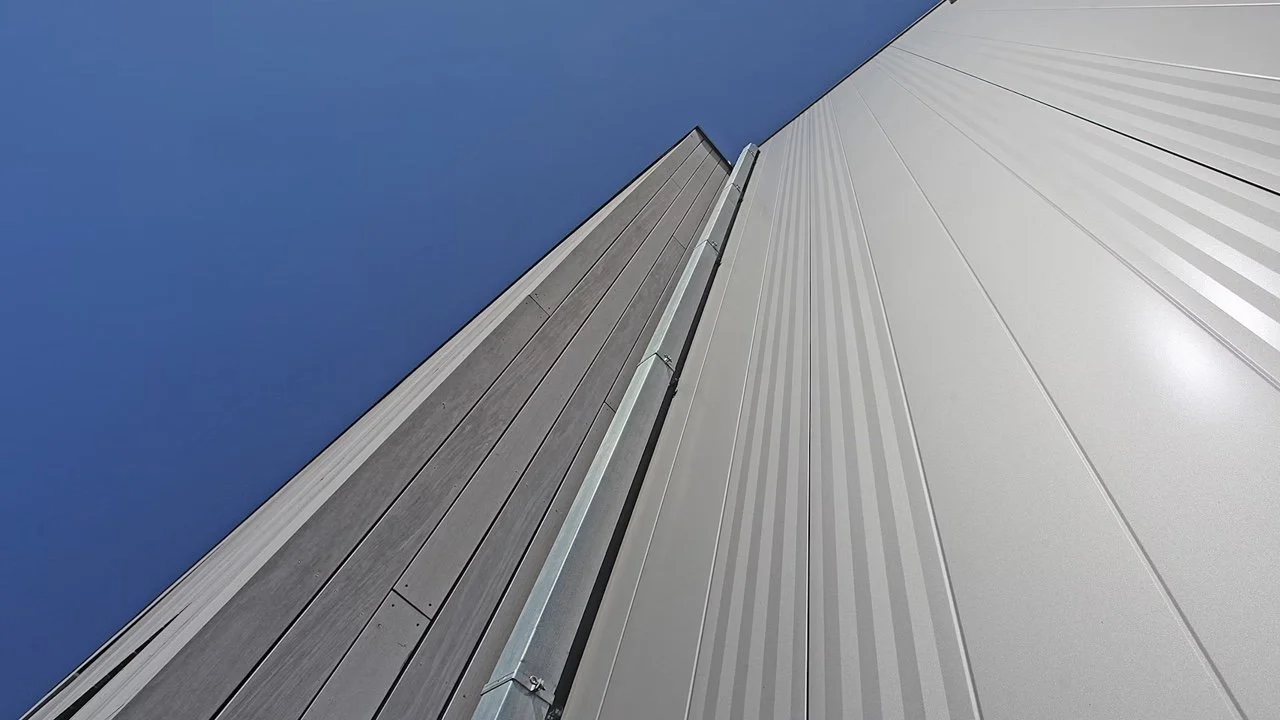
Brucha’s Specialty Voidless™ Facade panel:
FP•P•S
FPPS Insulated Metal Panel
A Complete Façade System in a Single Panel
Replace multi-trade wall assemblies with a pre-engineered system that delivers thermal performance, air and water tightness, and architectural flexibility—out of the box.
What is FPPS?
Built-up wall assemblies require a lot of faith. Faith that the framing crew and the insulation sub and the air barrier applicator and the cladding installer all showed up at full capacity, in sequence, without gaps. When they do, you get the wall performance you spec'd. When they don't — and something always doesn't — you find out later, in a blower door test or a claim.
Brucha's FPPS insulated metal panel doesn't work that way.
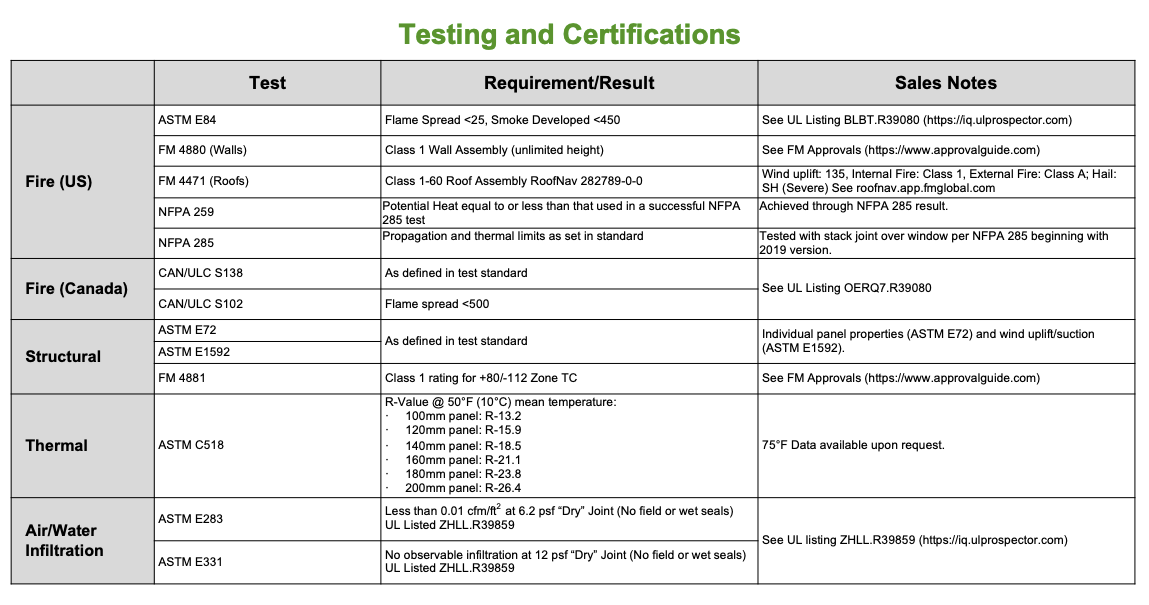
Fire resistance through FM 4880 and NFPA 285. Thermal performance from R-13.2 to R-26.4 depending on thickness. Air infiltration tested to less than 0.01 cfm/ft² at the joint — the exact point where traditional assemblies leak. Structural integrity rated under ASTM E72 and FM 4881. All validated as a single, tested system. Not components. Not layers. A system.
FPPS (Facade Panel Panel System) is a single-component insulated metal panel designed to replace traditional built-up wall assemblies.
Instead of coordinating multiple trades—framing, insulation, air barrier, and cladding—FPPS delivers all critical building envelope functions in one factory-engineered system.
Each panel includes:
Structural outer and inner metal skins
High-performance insulated core (PIR+ or mineral wool)
Integrated joint system for air and water control
Factory precision manufacturing for consistent performance
Result:
A faster install, fewer failure points, and predictable performance from day one.
Read the full article on the shortcomings of Built-Up!
Why Built-Up Walls Fail:
Multiple trades = variability
Interfaces = failure points
Performance = dependent, not guaranteed
What is a Voidless™ Facade Panel?
So glad you asked!. Brucha’s proprietary Voidless Core Technology means every panel comes off the line with absolute adhesion to the steel skins, and the foam is free of pockets, gaps, and voids that traditional manufacturers struggle to eliminate.
You can be sure that every panel we ship is manufactured to our industry-leading, stringent specifications. No exceptions, no excuses.
Take a look at the Testing and Certifications table above.
What this dataset is really showing is that the performance of Brucha’s insulated metal panels (IMPs) is not dependent on field execution—it’s pre-engineered, tested, and verified as a complete system. Across fire ratings, structural integrity, thermal performance, and air/water infiltration, the panels meet stringent ASTM, FM, UL, and NFPA standards as a unified assembly. You’re not looking at isolated component performance—you’re looking at system-level validation.
For example, fire resistance (FM 4880/4471, NFPA), thermal R-values (ASTM C518), and air/water tightness (ASTM E283/E331) are all achieved without relying on additional field-applied sealants or multi-step coordination. Even critical performance thresholds like air leakage (<0.01 cfm/ft²) are validated at the panel joint itself—the exact point where traditional systems tend to fail.

Now contrast that with a built-up wall assembly. In a traditional system, performance is fragmented across trades: framing, sheathing, vapor barrier, insulation, air barrier, and cladding—each installed by different crews, each introducing variability. The final performance is only as good as the weakest link, and coordination gaps are where inefficiencies—and failures—creep in. You’re effectively “hoping” that all layers align to achieve the intended outcome. With IMPs, that uncertainty is removed. The same engineered panel that delivers the thermal envelope also controls air, water, and structural performance. Installation becomes faster and more repeatable because it’s simplified—fewer steps, fewer trades, fewer failure points.

That’s where the real cost story emerges. While IMPs may appear more expensive upfront on a material basis, they compress labor, reduce coordination risk, accelerate timelines, and most importantly, deliver predictable performance out of the box. You’re not paying for perfection in the field—you’re buying it pre-manufactured. And that alignment between installation efficiency and performance reliability is what ultimately makes the system more cost-effective at the project level, not just the line-item level.
FAQ
Frequently Asked Questions
What is an insulated metal panel (IMP)?
An IMP is a factory-manufactured building component consisting of an insulating core bonded between two metal skins, designed to provide structural, thermal, and environmental performance in a single system.
How does FPPS reduce construction time?
By eliminating multiple installation steps and trades, FPPS allows contractors to complete the building envelope faster with fewer dependencies.
Are IMPs more expensive than traditional wall systems?
Material costs may be higher, but overall project costs are often lower due to reduced labor, faster schedules, and fewer performance-related issues.
Do FPPS panels require additional air or vapor barriers?
No. FPPS panels are engineered to provide air and moisture control within the panel system itself.
How does FPPS improve performance reliability?
Because performance is engineered and tested at the panel level, it does not depend on field-applied systems or multi-trade coordination.
System Performance (Not Component Performance)
FPPS panels are tested and validated as a complete system—not as individual materials expected to work together in the field.
Fire Performance
FM 4880 approved assemblies
NFPA 285 compliant systems
Thermal Performance
R-values ranging from R-13.2 to R-26.4 depending on thickness
Air Tightness
Less than 0.01 cfm/ft² at panel joint (ASTM E283)
Tested at the exact point where traditional assemblies typically fail
Water Penetration
No observable infiltration under ASTM E331 testing
Structural Integrity
ASTM E72
FM 4881
Because FPPS is installed as a single system, these performance values are preserved in the field—without relying on perfect sequencing or coordination across trades.
In Simple Terms
FPPS panels arrive on-site with performance already built in.
Instead of constructing a wall layer by layer and hoping everything aligns, installers attach a single panel that delivers the required thermal, air, water, and fire performance from day one.
What FPPS Replaces
Traditional wall assemblies rely on alignment across multiple trades and materials. FPPS eliminates that dependency.
A single FPPS panel replaces:
Exterior cladding systems
Continuous insulation layers
Air barrier systems
Vapor control layers
Multi-step façade assemblies
Performance is no longer assembled in the field. It arrives on-site already built into the panel.
Installation: From Sequencing to Completion
FPPS changes how walls get built.
Instead of managing a sequence:
Frame
Sheathe
Wrap
Insulate
Barrier
Clad
You install a single panel that completes the envelope.
For installers:
Fewer trades on site
Fewer steps to manage
Reduced installation time
Lower risk of rework
You’re not coordinating a system—you’re installing one.
FPPS vs. Built-Up Wall Assemblies
Built-up systems depend on execution.
FPPS depends on engineering.
Built-Up AssemblyFPPS PanelMultiple trades requiredSingle installation crewPerformance assembled in the fieldPerformance manufactured into the panelHigh coordination riskMinimal coordination requiredVariable outcomesPredictable, tested resultsExtended construction timelinesAccelerated installation
With traditional systems, performance is contingent.
With FPPS, performance is inherent.
Design Flexibility Without Added Complexity
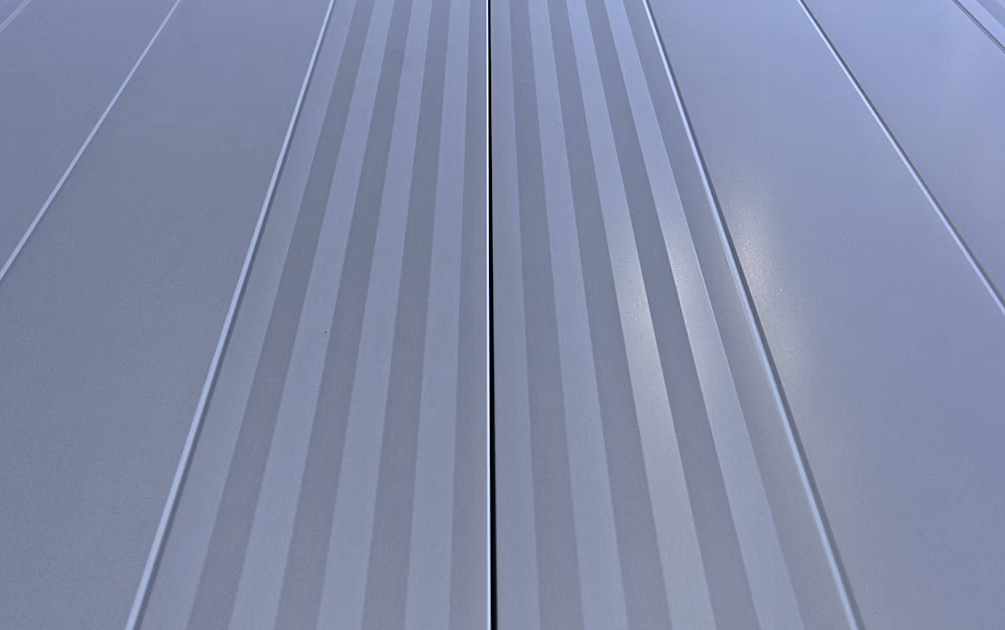
FPPS panels support multiple surface profiles within a single panel system, allowing architects to achieve varied façade aesthetics without introducing additional materials or labor layers.
Design freedom no longer requires construction complexity.
The Real Cost Equation
On paper, FPPS may appear as a higher material cost compared to individual wall components.
At the project level, it tells a different story:
Reduced labor requirements
Shorter construction schedules
Fewer trades to coordinate
Lower risk of callbacks and remediation
More predictable project outcomes
You’re not paying to assemble performance in the field.
You’re specifying a system that already has it.